
“Price is what you pay. Value is what you get.”Warren Buffett · Chairman, Berkshire Hathaway
Buyers do not pay for how much your business earns. They pay for how predictable, transferable, and defensible those earnings are once you are no longer in the building. Seven drivers decide where in the range you land.
1EBITDA is the foundation
Companies of this size are valued on a multiple of adjusted EBITDA. Strategic acquirers and private equity platforms with a gap to fill will pay more for the right fit. Below $1M, multiples compress quickly and the buyer pool changes.
How it works
$2M in EBITDA × 5x = a $10M purchase price. The same $2M at 6x is $12M.
Earnings are largely fixed by the time you go to market. The multiple is where the process, the preparation, and the negotiation do their work.
2Owner involvement
The more the business depends on you, the less it is worth. If the top five customer relationships, pricing decisions, and hiring all route through the owner, the buyer models a general manager’s salary as a deduction from EBITDA and applies a lower multiple to what remains. Building a management layer 18 to 24 months before market is the highest-return investment available to you.
3Revenue quality and predictability
Buyers pay a premium for revenue they can forecast. The order is consistent across industries: contracted recurring revenue at the top, then repeat revenue from a diversified base, then project revenue with a visible pipeline, then one-time work. A business with 60% or more of revenue under contract or reliably repeating supports a higher multiple. Lumpy project revenue, however profitable, is discounted because buyers and lenders see it as unpredictable.
- Multi-year contracts with defined renewal terms
- No customer above 25%; top 10 under 50%
- Net revenue retention above 100% on existing accounts
- Pricing history that shows increases held
- Gross-dollar retention above 90%
- Pipeline data exportable from a CRM, not a spreadsheet
4Market position and defensibility
A business that leads a defined niche is worth more than one that competes on price in a broad market. Buyers look for the reasons a competitor cannot simply copy what you do: regulatory licences, exclusive territories or distribution rights, a proprietary process or technology, switching costs built into the customer’s operations, and a brand that generates inbound demand. Be specific. “Strong relationships” is not a moat. A 14-year master service agreement with a hard-to-win customer is.
5Systems and reporting
Institutional buyers will fold your reporting into theirs within 90 days of closing. They look for a cloud ERP, a CRM with clean pipeline data, monthly management accounts closed within 15 days, and a controller who can produce a 13-week cash flow on request. Together those signal a business that can be run from a board seat. Systems do not add a turn on their own. Their absence takes one off.
6People and retention
The buyer’s worst outcome is acquiring a business whose key people leave in the first year. Low turnover, a defined structure, and strong people with written agreements are worth more than any single customer contract. Before you go to market, confirm which employees are critical, put retention or equity agreements in place, and document onboarding, training, and performance reviews. Talk to your advisor before raising a sale with staff: timing matters.
7Brand, reputation, and inbound demand
Intangibles are priced when they produce measurable outcomes. A brand that generates 40% of new business inbound, a Net Promoter Score above 50, a review profile a buyer can verify, and a professional digital presence all reduce the perceived cost of growth. They also signal a business run to a standard, which shortens diligence.
8Same size, different multiple
Two companies with $3M in EBITDA in the same industry can sell for very different prices. Size is not the main driver of the multiple. How easily the business transfers, and how much risk the buyer sees, come first. The stronger company has a general manager, three years of reviewed statements, a sell-side QoE, no customer above 15%, and a growth initiative with 12 months of data. The weaker one has a founder who knows every customer personally and a very good accountant. Buyers pay for certainty that the earnings continue after the wire clears.
9Short on time? What to prioritize
Seven drivers is a long list. You will not fix all of them, and you do not need to. What to do depends on your timeline.
Selling in the next 12 months: protect the number you have
- Commission a sell-side QoE now. It takes 6 to 10 weeks and sets the EBITDA the whole process is built on.
- Paper your top 10 customers with signed agreements and assignment language.
- Sign retention agreements with key managers, paid from proceeds and vesting after closing.
- Confirm the lease transfers. Landlord consent is a closing condition, so start early.
- Build the normalized EBITDA schedule with documentation for every add-back.
Selling in 1 to 5 years: raise the multiple, not just the earnings
- Hire or promote a general manager and give them 24 months to run the business while you step back.
- Move to a higher standard of financial statements so three clean years exist when you go to market.
- Reduce customer concentration below 25% through new accounts, not by shrinking the large one.
- Complete tax and estate planning: holding company, family trust, share classes, LCGE purification in Canada or QSBS planning in the US. Allow 12+ months.
- Launch one growth initiative that will have 12 months of revenue data by the time you go to market.
10What quality looks like at $1M+ in EBITDA
These are the rules of thumb buyers and their lenders use to sort a company of this size into the top or bottom of the range. Specific thresholds vary by industry.
No single customer above 25% of revenue, and the top 10 under 50%. Above that, expect an earn-out tied to that account or a price adjustment.
Healthy for services, distribution, and light industrial. Software and specialized manufacturing should sit above 30%. The trend matters as much as the level.
Revenue under contract or reliably repeating year over year. Above 60% supports the top half of the range and a lender’s confidence.
Two years in a row above 10% supports a premium. Flat revenue caps the multiple at the low end, whatever the margin.
Time from invoice to cash. Long collection cycles raise the working capital the buyer must fund and reduce your cash at closing.
Revenue growth rate plus EBITDA margin. Above 40, buyers accept whichever trade-off you have made.
Nobody clears every benchmark, and no buyer expects you to. What they price is the pattern. Miss one and you get a diligence question. Miss two and you are into a conversation about structure: an earn-out, a bigger holdback, less cash at closing. Miss three or more and it comes off your multiple. The best time to start exit planning was yesterday. The only downside is a business that is easier to run and more predictably profitable.
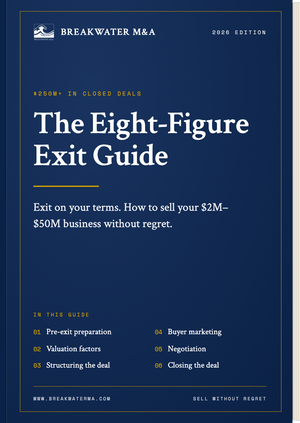
Read it before a buyer calls.
All six chapters, the valuation worksheet and the exit checklist in one free PDF.
Download the full PDFPrefer to talk it through? Book a confidential call →
This guide is general information about selling a business. It is not tax, legal, or accounting advice and does not account for your specific circumstances. Tax and corporate rules differ between Canada and the US and change over time. Speak with a qualified tax, legal, and accounting professional before acting on anything recommended in this guide. Breakwater M&A is not a law firm or an accounting firm.