
Chapter 1 · 9 min read
Pre-exit preparation: anticipating what buyers will diligence
“You don’t get what you deserve. You get what you prepare for.”Chris Voss · Former FBI lead hostage negotiator
Preparation is where most of the value in an exit is created or lost. At $1M+ in EBITDA, buyers arrive with a checklist, often more than 100 request items. Your job in the 12 to 24 months before going to market is to have as many of those files ready as possible.
1Financial credibility
For Canadian businesses you will want reviewed or audited statements: compiled statements (what most accountants provide) are not enough at this scale. Move to reviewed statements at minimum. If you expect a purchase price above $15M–$20M or an institutionally backed buyer, you may need audited statements or a quality of earnings (QoE) completed. Three years of history is the standard ask, plus a current trailing-twelve-month view.
A sell-side QoE, completed before you go to market, validates your adjusted EBITDA before the buyer’s accountant does, surfaces problems while you still control the narrative, and shortens diligence. Budget $40K–$100K depending on complexity. On a $10M transaction, a QoE that defends $200K of add-backs pays for itself ten times over.
Normalized EBITDA schedule: Document every adjustment: owner compensation above market, one-time legal fees, related-party rent, discontinued lines. Each add-back needs a paper trail. An undocumented add-back is a buyer discount waiting to happen.
2Management depth
Management depth is the single largest value driver at this scale, ahead of growth rate and profit margins. Buyers are rarely just buying EBITDA. They are buying the team that can keep producing and growing it after you leave.
The test is simple: a second-in-command who can run the business for 90 days without you, functional leads in sales, operations, and finance who own their numbers, and long-term retention agreements signed before you go to market rather than negotiated as a condition of closing.
3The four risk buckets a buyer evaluates
Every buyer runs the same mental exercise. They list what could go wrong after closing, underwrite that risk, and then reduce their offer or change the deal structure. Their concerns fall into four buckets: financial, people, operational, and legal. Most companies at $1M+ in EBITDA are not strong in all four, and buyers price in every weak one. Your preparation is the same exercise, run 18 months before a sale process.
Financial
- Three years of review-engagement or audited statements
- Sell-side QoE complete, add-backs documented
- No customer above 25% of revenue; top 10 under 50%
- Monthly books close within 15 days; trailing twelve months up to date
- Legal liabilities cleared; leases transferable to a buyer
People
- Employment agreements in place for all staff
- Retention and incentive packages signed with key managers
- Org chart with named succession for each function
- No open HR claims, grievances, or regulatory issues
- Severance exposure calculated and disclosed
Operational
- Core processes documented (SOPs) and followed without owner input
- ERP, CRM, and reporting systems produce clean data
- Key supplier agreements assignable on change of control
- Clear forecast of annual capital spending
- Cyber, privacy, and data policies current
Legal and corporate
- Minute book and share register current and reviewed
- Intellectual property assigned to the company, not the founder
- Customer contracts assignable, or consent process mapped
- Leases reviewed for change-of-control and renewal terms
- No outstanding disputes with customers, suppliers, or staff
4Think like the buyer’s investment committee
Every offer you receive has already been reviewed by someone before it reaches you. That might be the buyer’s business partner, their accountant or lawyer, or on larger deals a formal investment committee or board. Working with your M&A advisor, your job is to make it easy for the buyer, now your advocate, to pitch and defend your business to them.
Common issues they flag
- Owner dependence: which relationships, decisions, and approvals still run through you. Buyers model the cost of replacing you and deduct it from EBITDA.
- Customer concentration: any account above 20% of revenue triggers a call with that customer in diligence and, usually, an earn-out tied to their retention.
- Change-of-control provisions: contracts, leases, and licences that need consent to assign. Each one is a closing condition you do not control.
- Earnings quality: how much of the EBITDA is recurring, how much is project-based, and how much depends on adjustments the buyer has to accept on faith.
5Four moves before you go to market
Fix the structure early
Holding company, family trust, and share-class planning need 12 to 24 months of runway before a sale. Purification for the Lifetime Capital Gains Exemption in Canada, or qualifying for the Section 1202 QSBS exclusion in the US, cannot be done at LOI. Get your tax advisor and your M&A advisor in the same room a year before you plan to go to market.
Lock in the contracts
Convert verbal arrangements with your top 10 customers into signed multi-year agreements with clear assignment language. Do the same with critical suppliers.
Retain the team before market
Retention bonuses funded from proceeds, vesting 12 to 24 months after close, signed before the first buyer conversation. A buyer who sees the team already committed prices the business as a going concern instead of worrying about what happens if key employees leave.
Prove the growth, do not describe it
A new service line with six months of revenue is worth more than a five-year forecast of an idea. Buyers underwrite what they can see in the trailing twelve months and give little credit to spreadsheet forecasts.
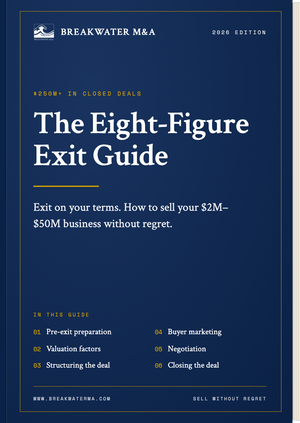
Read it before a buyer calls.
All six chapters, the valuation worksheet and the exit checklist in one free PDF.
Download the full PDFPrefer to talk it through? Book a confidential call →
This guide is general information about selling a business. It is not tax, legal, or accounting advice and does not account for your specific circumstances. Tax and corporate rules differ between Canada and the US and change over time. Speak with a qualified tax, legal, and accounting professional before acting on anything recommended in this guide. Breakwater M&A is not a law firm or an accounting firm.