Curious about Buying or Selling Digital Marketing Agencies?
WATCH FULL RECORDINGWatch the full recording of our live session with M&A Advisor and receive a FREE valuation.
Watching the webinar will automatically give you access to our PDF guidebook and post-webinar materials.
In this 45-minute session, we’ll cover:
How we marketed 2 different landscaping businesses doing $567K and $911K in revenue
What made the buyers stand out from the competition
What drove valuation, and what nearly killed both deals
Deal structure, diligence, and hard-earned lessons along the way
Anonymous Q&A session with attendees
What You’ll Learn
FREE BUSINESS EXIT GUIDEBuild your million dollar exit
Comprehensive exit planning checklist for the owners of businesses with $2 - $20 million in revenue.
Psst - book a free value assessment here
Clients with Successful Exit Stories
Hear their full stories on the case studies page here
“Breakwater's expertise was invaluable throughout our acquisition of a competitor. Their third-party perspective helped us navigate emotional dynamics smoothly, keeping negotiations professional and productive.
The acquisition quickly exceeded expectations, delivering immediate returns and positioning us strongly for future growth.”
Murray Seward
“When I first planned on selling my business, I thought I could do it without any support. But now that I have gone through the process, I was relieved to have the Breakwater team there to support me along the way. They certainly added value!”
Zac Roff
Book your free valuation
Why entrepreneurs trust Breakwater
We prefer to let our results speak for themselves: here’s what our clients have to say about working with us

Valkyrian Canning, Vancouver Island's exclusive mobile canning provider, grew revenue 198% in three years and drew more than 50 interested buyers. When the first buyer walked away, a second buyer from the same process closed. After the sale, revenue rose another 89% and EBITDA margins improved.
Murray Seward bought a local competitor to grow his whitewater rafting business, and margins rose 20%. In this conversation he explains how the deal came together, why an intermediary mattered when emotions ran high, and what changed after closing.
Common Questions
Have specific questions? Schedule a confidential consultation call below:
-
Our success fee ranges between 3% to 10% depending on the size of your business (bigger business = small fee).
We also charge a small upfront or monthly fee that is subtracted off the success fee at closing.
The purpose of the upfront fee is to ensure we’re both invested in the process as we invest hundreds of hours on each deal.
-
The internet will tell you there is a bunch of ways to value a business.
In reality, most of our clients businesses are valued based on a multiple of the businesses profit.
Note: calculating profit for M&A deals is more complicated than looking at your taxable income. This is why we offer a free valuation for entrepreneurs - even if they are not planning to sell in the near future.
-
The boring answer = it depends.
That being said, our general guidance is that it often takes 6-8 months to sell a business.
However it is not uncommon for a sale to take over 12 months.
-
Most of our clients already have tons of inbound buyer interest - so why hire Breakwater?
Well, these clients also want to maximize their exit potential with the least amount of work possible. This is where Breakwater comes in to generate far more value than our fees.
Want to learn more about buying and selling?
Read our recent thoughts on buying and selling businesses by visiting our blog.

RCM contracts renew, compliance keeps rivals out and fund-backed buyers know it. Here is why they want RCM firms and what to check before you sell.
Managed services revenue renews every month, and fund-backed buyers know it. Here is why they want MSPs and what to check before you sell.
ESOPs and EOTs can both help you sell to employees, but they offer very different outcomes. Compare U.S. tax treatment, seller financing, employee benefits and long-term control before deciding which structure fits your business.
If you want a partner to sell a founder-led business worth more than $5M, choose on size fit, sector experience, process, fees and who does the work.
Fire and life safety revenue repeats because the code says it must. Here is why fund-backed buyers want it and what it means for your firm.
Selling to an ESOP can reward your employees and preserve what you built, but the financing and long-term obligations must work. Here is how U.S. business owners can compare employee ownership with a management buyout or outside sale.
Fund-backed buyers want recurring, regulation-driven testing revenue. Here is why they are buying TICC firms and what it means if you own one.
Buyers pay for monthly recurring revenue, not for installs. Here is how to sell a security systems and monitoring company, step by step.
Selling your Canadian business to an employee ownership trust can shelter up to C$10 million of eligible capital gains, but the benefit is conditional and shared among eligible sellers. Learn how qualification, filing, financing and post-sale compliance fit together.
Buyers price an RCM firm on how predictable and defensible its fees are. Here is what moves your multiple and how to prepare.
Buyers price a CRO or laboratory on how much of its earnings will repeat. Here is what moves your multiple, who buys, and how to prepare.
Regulation creates demand that repeats, and buyers pay for it. Here is what moves the multiple for an environmental testing or TICC firm.
Five kinds of buyer purchase MSPs, and each prices your firm differently. Here is who they are, what they want and what to check in their offers.
Your monitoring base sets your multiple. Learn how buyers read RMR, attrition and contract terms, and how to improve all three before you sell.
Most owners have no idea what their company would sell for. This framework shows how professional buyers actually value businesses through normalized earnings, multiple ranges, buyer types, and deal structure, so you can estimate a defensible range.
Buyers pay more for revenue that repeats without a new sale. Here is how inspection and monitoring contracts shape a fire protection company's value.
Five kinds of buyer purchase software companies. Learn what each pays for, which metrics decide your price and what to check in every offer.
Choose the advisor who has sold software companies like yours and tells you plainly how they are paid. Here is the checklist we would use.
Broker or M&A advisor? The right answer depends on your company's size and complexity. Here's a plain-English comparison for founder-led businesses.
A strong exit strategy is the difference between selling your business on your terms and being forced into a deal you regret. Here's how to plan, prepare, and time your exit for maximum value.
Agencies aren't valued like other businesses. Here's how to pick an M&A advisor who actually understands retainer economics, concentration risk, and agency buyers.
Buyers decide quickly whether a business is sale-ready. Run this 7-point founder's checklist before you ever talk to one.
Acquiring a company is one of the fastest ways to grow, but only if you get the process right. This step-by-step guide covers how to find, evaluate, finance, and close a company acquisition in 2026.
Wondering whether to sell to a strategic buyer or a financial buyer? Here is how each buyer type values your business, structures the deal, and shapes your life after the transaction.
Home services businesses - HVAC, plumbing, electrical, landscaping, cleaning, roofing - are among the most sought-after acquisition targets in the lower middle market. This guide walks buyers through every step of the process, from sourcing deals to closing day.
Selling a business in Toronto means navigating Canada's largest and most competitive M&A market. This guide covers how to find the right broker, what Ontario buyers are paying, and how to position your company for a premium exit in the GTA and beyond.
The SBA now mandates an independent quality of earnings report for 7(a) change-of-ownership loans of $3 million or more. Here is what the new rule means for buyers, sellers, and lenders, and how to prepare before it takes effect on October 1, 2026.
Thinking about selling your landscaping business? This 2026 guide covers valuation multiples, buyer types, deal structures, and the exit planning steps that separate average deals from premium ones. Built for landscaping company owners doing $1M–$20M in revenue.
Selling your business is one of the biggest financial decisions you will ever make. This guide walks you through the entire process - from knowing when you are ready to sell, to valuation, finding buyers, negotiating terms, and closing the deal.
Cleaning and janitorial companies are attracting strong buyer interest in 2026. Here is how your business is valued, what multiples to expect, and how to position for maximum exit value.
Book your free valuation
Learn the M&A Terms That Actually Matter
The M&A world is full of jargon, but it doesn’t have to be confusing. We’ve created short, easy-to-understand videos that break down the most important terms in our M&A Education Library.
Most business owners lose leverage the moment they commit to a single buyer. Learn why "one buyer is no buyer," how single-buyer deals fall apart, and why running a competitive sale process delivers on average a 25% higher sale price.
Private equity is betting big on landscaping and blue-collar businesses. Here's why fragmented service models, recurring revenue, and AI disruption are turning these overlooked sectors into M&A goldmines.
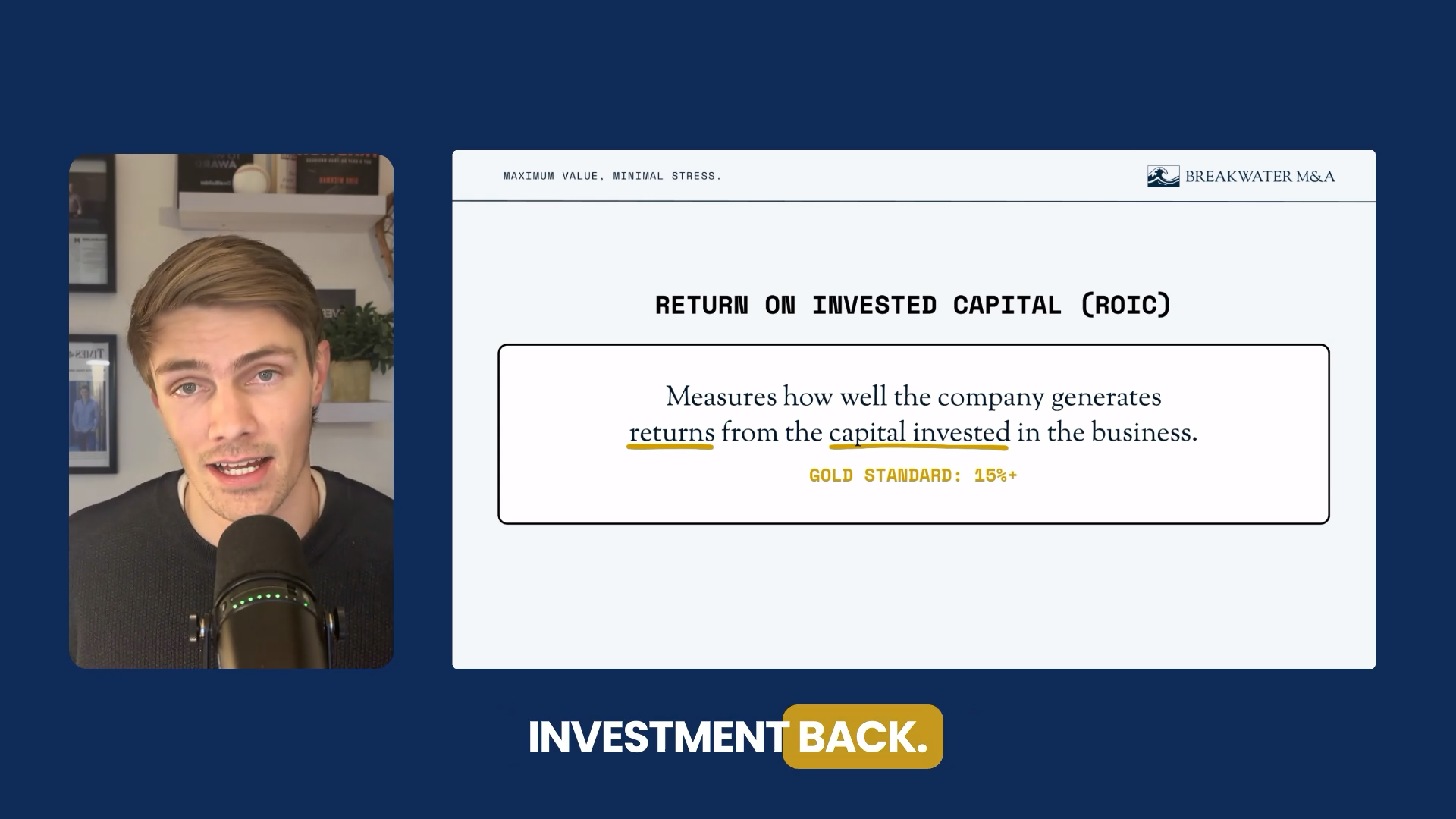
Most founders focus on revenue growth or profit margins, but the smartest investors pay attention to Return on Invested Capital (ROIC).
ROIC measures how efficiently your business turns every dollar of capital, both your money and borrowed funds, into real after-tax profit. It’s the ultimate test of whether your company is compounding value or just burning cash in motion.
For established businesses, a ROIC north of 15% is considered strong; for acquisition entrepreneurs, 20–30%+ is the real target. High ROIC means your capital is working harder than your competitors’, which directly translates to faster wealth creation and stronger buyer demand when it’s time to sell.
At Breakwater M&A, we help entrepreneurs understand and improve ROIC before they buy or exit a business, because efficient capital turns good operators into great investors.
The EBITDA margin is one of the first numbers buyers check when reviewing your business. It strips away financing and tax effects to show true operating profitability. Learn what it means, the gold standard benchmark, and how to improve it before selling.
The current ratio is a simple way to measure whether your business can comfortably pay its bills. Buyers use it as a quick check of financial stability. Learn what it means, the gold standard benchmark, and how to improve it before selling.
The asset turnover ratio shows how efficiently your business turns assets into sales. A higher ratio signals lean operations, and that’s exactly what buyers want to see. Learn the gold standard benchmark, why it matters in M&A, and how to improve it before going to market.
Discover what a sell-side M&A advisor really does during a business sale. Learn how they guide owners through valuation, marketing, negotiations, and closing, ensuring a smooth, successful transaction while maximizing value. Perfect for first-time sellers with $5M–$50M in revenue.
Most startups fail. So why not buy one that already works? In this video, Morgan from Breakwater M&A explains why buying an existing business may be the faster, more strategic path to entrepreneurship.
At Breakwater M&A, we use a confidential, strategic process to market your business and attract the right buyers. In this video, Morgan explains how we find financial, strategic, and entrepreneurial buyers, and how we maximize value while protecting your privacy.
A Letter of Intent (LOI) sets the tone for a successful deal. In this video, Morgan from Breakwater M&A explains how to structure an LOI that outlines key terms, protects both parties, and increases the chances of getting your offer accepted.
Seller financing is a common deal structure used to bridge the financing gap in business acquisitions. In this video, Morgan from Breakwater M&A explains how seller financing works, what typical terms look like, and how both buyers and sellers can benefit, when it’s used correctly.
When buyers and sellers can’t agree on a business’s value, an earn-out can help bridge the gap. In this short video, Morgan from Breakwater M&A explains how earn-outs work, why they’re used in M&A deals, and how to structure them fairly. Learn how tying part of the purchase price to future performance can protect buyers and give sellers upside, when done right.